Workers stay where they feel safe: how safety culture becomes a vital staff retention tool

In 2025, the UK government set out an ambitious 10-year infrastructure plan. What it lacks is the workforce to deliver it.
While the plan brings many opportunities for construction firms, a shortage of skilled workers in the UK is a very real concern. As the industry becomes more competitive, these firms must prepare to do more to attract and retain their workers.
In this article, we examine the relationship between safety culture and retention. How much does safety matter to workers? How is this likely to change as the labour market shifts? And how should leaders prepare for it?
The construction labour market is changing
The Construction Skills Investment Package, shared in May 2026, details the UK government’s plans to get more people into the construction industry.
But those casting a critical eye over the package have flagged the shortfall between workers added and workers required: the package aims to add up to 60,000 construction workers to the UK economy by 2029, a far cry from the 755,000 additional workers the government itself predicted it may need to meet its objectives by 2030.
With nearly half a million skilled construction workers set to retire in the next 15 years, and a much lower number predicted to enter the industry, demand is set to significantly outstrip supply in the years to come.
This shortfall means we can expect these skilled workers to be more selective about where they work in the future. The basics of pay and location will no doubt continue to be critical, but many will have the option to evaluate each job from a more holistic perspective – both before joining and once on the team.
Construction firms must be prepared to compete for their workforce, investing in creating an environment and reputation that both attracts them and retains them.
Safety matters deeply to workers
A recent report found that 80% of workers in the UK view the physical safety of a workplace as an important factor when choosing an employer. According to the same report, 76% of UK workers agreed that a poor/bad workplace environment can lead them to change employers.
It’s easy to mentally ringfence Health and Safety as an isolated function. To view its role as solely minimising the number of incidents and near misses (and the cost and disruption they cause), and keeping projects moving safely and lawfully.
But these statistics validate what we already know to be true in practice: the impact of workplace safety is far more foundational and far-reaching than this.
Safety culture, whether good or bad, has a substantial ripple effect throughout an organisation, and this will only become more true as demand for skilled workers increases and supply wanes. As such, safety must be considered as a retention tool, not just a compliance one.
Make safety the culture, not an afterthought
Most construction firms list safety as one of their values. In practice, we see that competing priorities make it hard for firms to keep safety at the core of how they work.
It’s easy to follow safe procedures when the sun is shining, the project is running on time, and everyone and everything is where it’s meant to be.
The real test of your safety culture is how your team responds when the schedule is slipping, and the pressure is mounting: will they do whatever it takes to get the job done, or will they speak up and step back, holding firm on what they know keeps them safe? And can they do the second without fear of reprimand?
This is how an organisation’s safety culture is stress-tested. Workers can feel the difference between an organisation that holds safety at its core and one that just writes it on its website.
Retention and safety: a self-enforcing partnership
The evidence points to a clear link between workplace safety and retention.
But we’d take this one step further, suggesting the relationship between safety and retention is reciprocal: staff are more likely to stay at safe workplaces, but it also stands to reason that firms with better staff retention find it easier to build a good safety culture.
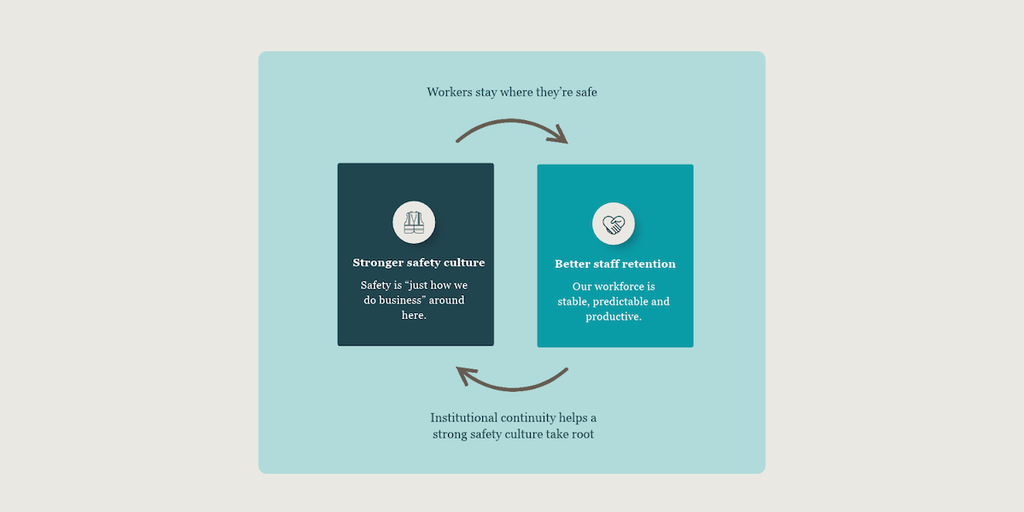
It’s harder for organisations to establish shared values and a shared way of working when there’s a revolving door of workers and contractors. When a workforce is more stable, when there’s institutional continuity, a good safety culture has a better chance of taking root and becoming instinctive (“just how we do business”), with new joiners quickly falling into step with the behaviour they see around them.
That’s not to say a good safety culture just happens by default (it’s something that must be actively nurtured), but this does make things simpler.
When a workforce is steady, plans are also more likely to go to plan. Teams are less likely to become stressed and overtired from picking up slack caused by absences or new joiners who are still learning the ropes.
Centre employee wellbeing in your future planning
The construction labour market is changing. A triple combination of ambitious delivery plans, an ageing skilled workforce, and low industry intake levels is set to leave demand well above supply in the years to come.
The firms that will win and deliver future projects understand that their workers don’t just need a good reason to join; they need the right conditions to stay.
On the flip side, firms that don’t take steps to nurture a culture of safety and improve employee wellbeing now may experience an unstable workforce in the future. And this comes with its own costs: above-market wages, workforce disruption and onboarding/hiring costs, and incident-related delays or penalties
So how do we take this knowledge forward? Leaders must see the role of the Health and Safety department, and related safety and wellbeing activities, through a new lens: safety culture isn’t purely a safety matter; it’s a question of future workforce stability.
At Active Training Team, we’ve been running award-winning safety training programs for high-risk environments since 2007. Our immersive training is designed according to neuroscientific, psychological and learning theory principles to make sure it truly sticks, and also focuses on shifting company culture to make everyone a safety leader. Contact us for more information here.