What does it mean to create a culture of safety?
An organisation’s ‘safety culture’ is a measure of how well it handles matters of safety. But it’s not just a question of training schedules, procedures and inspections; it’s about how senior leaders and site staff actually plan and behave every day.
‘Safety culture’ matters most in industries that are statistically more dangerous, such as construction, but every business has a safety culture – whether it’s good or bad.
Even in these more dangerous fields, a ‘good safety culture’, or a ‘culture of safety’, isn’t the default option, as you might expect. After nearly 20 years of working with these organisations, we’ve seen first-hand that a good safety culture doesn’t just happen – it’s something that must be actively developed and nurtured.
So what is a good safety culture?
How do you benchmark something as seemingly abstract as safety culture? In 2006, two professors put forward an answer.
Created for oil and gas companies, the ‘safety culture ladder’ (also known as ‘Hudson’s 5 levels of safety culture’ or ‘Hudson’s Safety Culture Model’) shows a sliding scale of five key safety culture stages. The theory being: it’s easier to shift your safety culture in a positive direction when you can understand where it sits right now.
We’ve adapted this model based on our work with organisations in the construction, utilities and transport industries:
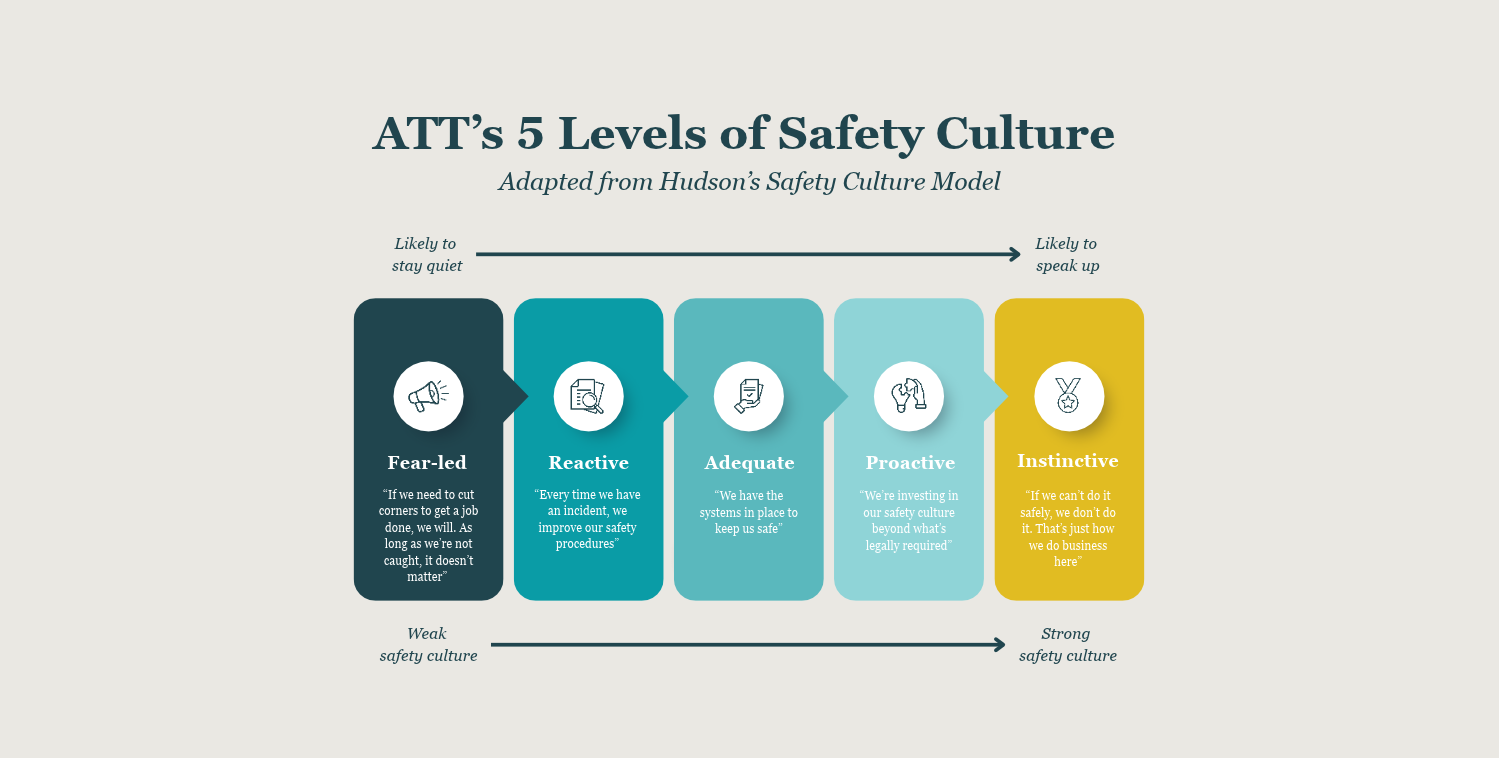
Strongest: Instinctive safety culture
This is the gold standard of safety culture. People who work for an organisation with an ‘Instinctive’ safety culture don’t think twice about acting safely and calling out risks as they spot them; it’s just how they do business.
Safety is one of the organisation’s core values. Incidents happen, of course – but they’re rarer, treated seriously, and actively learned from.
An Instinctive safety culture in action:
- The organisation invests in regular safety training that changes attitudes to safety, and doesn’t just tick a box.
- Everyone is a safety leader, calling out risks as they spot them. This behaviour is meaningfully encouraged, and concerns are listened to and remedied.
- Senior leaders do not place undue pressure on site teams to deliver projects faster than is reasonable, with too few people, or with unsuitable equipment. No matter what challenges they’re facing, safety is the core, unwavering value that they work by.
These, and hundreds of similar decisions and day-to-day moments, are what it means to have a good safety culture.
Weakest: Fear-led safety culture
At the opposite end of the ladder is a weak safety culture, or what we’ve labelled a ‘Fear-led’ safety culture.
This is a safety culture that’s driven by fear of punishment, rather than a genuine belief in the importance of safety procedures. The prevailing attitude might be “who cares what we do as long as we get the job done and we’re not caught”. As you might imagine, this is the kind of safety culture that keeps Safety Directors up at night.
A Fear-led safety culture in action:
- A higher-than-average rate of significant and near-miss incidents, with plenty more going unreported.
- Site teams being forced to cut corners or work long hours to meet unrealistic deadlines.
- Safety isn’t something that’s policed by anyone besides the Safety Director and their team. Workers may feel like it’s not worth speaking up or may fear being penalised or mocked for doing so. Others may be sceptical about health and safety full stop (“I’ve always done it this way, and I’ve been fine!”).
How do you create a culture of safety?
While it won’t change overnight, an organisation’s safety culture certainly isn’t fixed in place. Any organisation can shift to the next level of safety culture if its leaders are willing to commit the time and resources.
Changing culture is complex, and relies on multiple shifts happening in tandem, tackling top-down policies and bottom-up attitudes simultaneously:
1. Senior leaders must minimise risk-causing factors
Site teams that are overtired, overworked or understaffed are more likely to make mistakes and cut corners. Working with machines that are poorly maintained is more likely to lead to incidents. When speed or cost is prioritised above all else, this ripples down an organisation – and worker safety suffers.
If that sounds like a bit of a leap, consider your own day-to-day behaviour. There’s a reason we’re more likely to rush out into the road when we’re running late, inexplicably leave our phone in the fridge when we’re bone-tired, or drop the ball when our to-do list is overflowing. The same principles apply to site work; the stakes are just much higher.
Rather than considering them accidents that are unavoidable, senior leaders should understand that incidents don’t happen randomly; they are typically the conclusion to a long chain of events, big and small, that crescendo to one key moment.
So what needs to change? Senior leaders must encourage site workers to flag unsafe behaviour and scenarios, and stay true to their word, rewarding people for coming forward and taking their concerns seriously.
Fostering a psychologically safe environment – where the personal cost of speaking up feels smaller than the cost of staying silent – is crucial. This is how we break the chain.
2. Everyone must become a safety leader
Alongside reducing risk-causing factors, improving safety culture requires shifting everyone’s attitude towards safety.
Even when working conditions aren’t unreasonably pressured, workers in organisations with poor safety culture might see health and safety practices as unnecessary red tape that slows them down. Workers in organisations with a strong safety culture understand that the rules are in place to keep themselves and those around them safe.
In reality, achieving this mindset shift is harder than you might think. Various psychologists have indicated that the human brain isn’t wired to think deeply about distant consequences or remote danger in the moment; it’s much more concerned with visible risks and real-time feedback. Speaking about this topic on NPR, Professor Daniel Gilbert uses the example of many people being more concerned about terrorism than global warming, despite the odds of being affected by the latter being much higher. Research has even suggested that immediate, visible dangers have their own, more efficient ‘fear circuit’ within the brain.
This makes it all too easy for us to become lax over time about the risks a site poses.
For example, the first time you cut across a vehicle path on site, you know you’re doing something risky. Your heartbeat might even rise a little, your eyes flicking back and forth to double-check for danger. Next time, your brain remembers that nothing bad happened last time, so you’re more relaxed, a little less vigilant. Before long, you’re ambling across while checking your phone, oblivious to the danger around you. And just like that, a one-time blip becomes a habit that needs rewiring.
Good safety training is a catalyst, not a shortcut
Good training is not a shortcut to a better safety culture, but it can play an important role.
And when it comes to shifting culture, choosing the right training matters.
Standard safety training shows the correct procedures, but it doesn’t always provide that extra impetus to follow them. The risks can feel abstract, not helped by the fact that the setting is often a million miles away from the day-to-day reality of site life. It might teach the theory, but will it make enough of an impact for workers to speak up when they’re in a high-pressure situation?
The science tells us that good immersive training that involves participants is more likely to stick, and therefore to support cultural change, in part because it taps into our emotional response. This helps solidify training in our long-term memory, bring the reality of the risks to life, and also makes the learnings easier to recall when the pressure’s on. In essence, it makes us more likely to do the right thing when the moment comes.
At Active Training Team, we’ve been running award-winning safety training programs for high-risk environments since 2007. Our immersive training is designed according to neuroscientific, psychological and learning theory principles to make sure it truly sticks, and also focuses on shifting company culture to make everyone a safety leader. Contact us for more information here.